
Updated July 2024: Case studies are a critical element of most SaaS marketing strategies. But what case study questions do you ask in the customer interview to ensure you elicit the details AND emotion you need for an authentic and compelling story?
In research we conducted this year, SaaS marketers ranked case studies the #1 most effective marketing tactic to increase sales—ahead of general website content, SEO, blog posts, social media and other marketing tactics.
But gathering the insights, data and customer quotes that make a case study resonate takes some finesse. This is why it’s so important to develop a set of relevant case study questions for interviews with customers.
Get 26 case study questions, PLUS 19 bonus questions for use case, adoption and switcher stories. Download the cheat sheet now.
What case study interview questions should you ask?
In this post, we share the 26 powerful case study questions we use when conducting a case study interview.
We also include favorite case study interview questions and hot tips from customer marketing and advocacy practitioners in our industry:
- Natalie Gullatt, Customer Lifecycle and Growth Manager, Artera
- Cecilia Wainio, Customer Growth, Jitterbit
- Helen Feber, Founder, Referential
- Luis González, Head of Global Customer Advocacy, Alteryx
- Deirdre Puleo, former Content Strategist, Wix
- Kaily Baskett, Director of Revenue Growth, SlapFive
- Jeff Ernst, CEO, SlapFive
- Gabriela Contreras, Independent Marketing Consultant
- Erin O’Quinn, Senior Manager, Customer Marketing, VMware by Broadcom
- Cassie Stevenson, Global Customer Advocacy Lead, Qumulo
- Cindy Aitken, Director, Customer Marketing, Collibra
- Diana Yanez-Pastor, Independent Customer Advocacy Marketing Consultant
With these insight-eliciting case study questions in your back pocket, you’ll be able to uncover nuggets of gold that will help you create a customer story that really resonates with your prospects and leads.
Also learn how to conduct a good case study interview
In this post, we also cover tips for conducting a great case study interview, as well as some common interview mistakes to avoid.
- Before the case study interview
- Find a convenient time for the interview
- Prepare your case study questions in advance
- Should you send the case study questions to your customer ahead of time?
- Make your customer comfortable
- 26 case study questions for interviews with customers
- Bonus case study interview questions
- An email interview won’t cut it
- Take notes and record the interview
- Watch out for these 4 common interview mistakes
Get a cheat sheet with 26 case study questions, PLUS 19 bonus questions for use case, adoption and switcher stories. Download the cheat sheet now.
Before the case study interview
Keep in mind that there are 3 important phases to any case study:
- Before: What were the customer’s pain points, challenges, priorities and aspirations before they found you?
- During: Why did the customer choose your solution? How did the implementation go? How are they using your solution?
- After: What can the customer do now that they couldn’t do before? What impact has your solution had on their business?
The best case studies draw readers in by walking them through these phases by using case study testimonials and details that bring the story to life and make it more compelling.
Find a convenient time for the interview
Your customers are busy—and they’re doing you a big favor by participating in the case study—so be as flexible as possible when you’re scheduling the case study interview. And while you’ll likely want to talk to them for hours, be respectful of their time and ask for 30 minutes.
Prepare your case study questions in advance
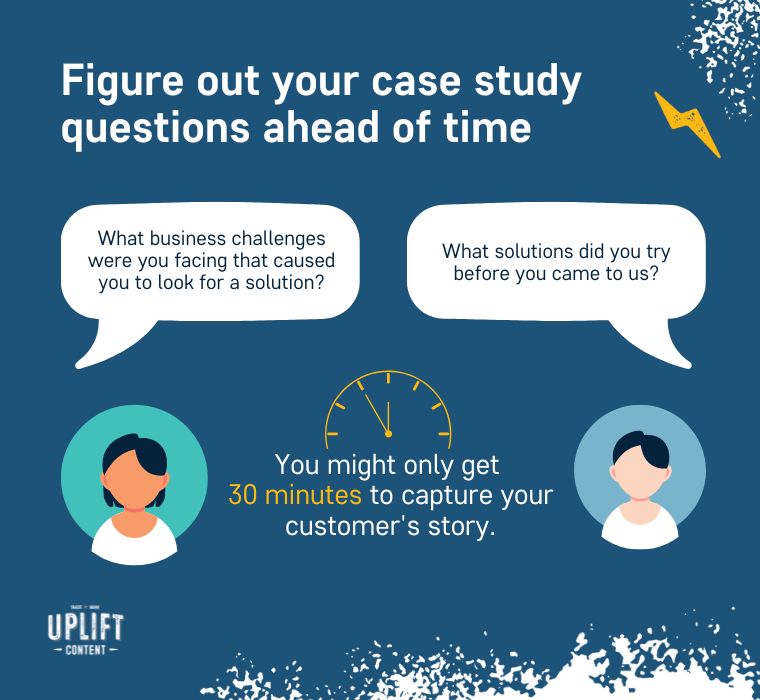
You’ll probably have just 30 or 40 minutes to capture your customer’s story so be thoroughly prepared before you even schedule the case study interview.

Hot tip: How to prepare for an interview
Here are three things you should do before each interview:
1. Ask the CSM or account manager about the account.
2. Review the account details in the CRM or customer management tool.
3. Customize your interview questions to ensure they align with the story you’d like to tell, your company’s goals and the customer’s success.
Should you send the case study questions to your customer ahead of time?
This is hotly debated amongst customer marketing and advocacy professionals.
Some people worry that sending the case study interview questions in advance will result in less candid and natural responses.
Others argue that it’s important to provide the case study questions for interviews with customers ahead of time so they have time to think about their responses and dig for metrics.
So, we did a quick poll and here’s the consensus:
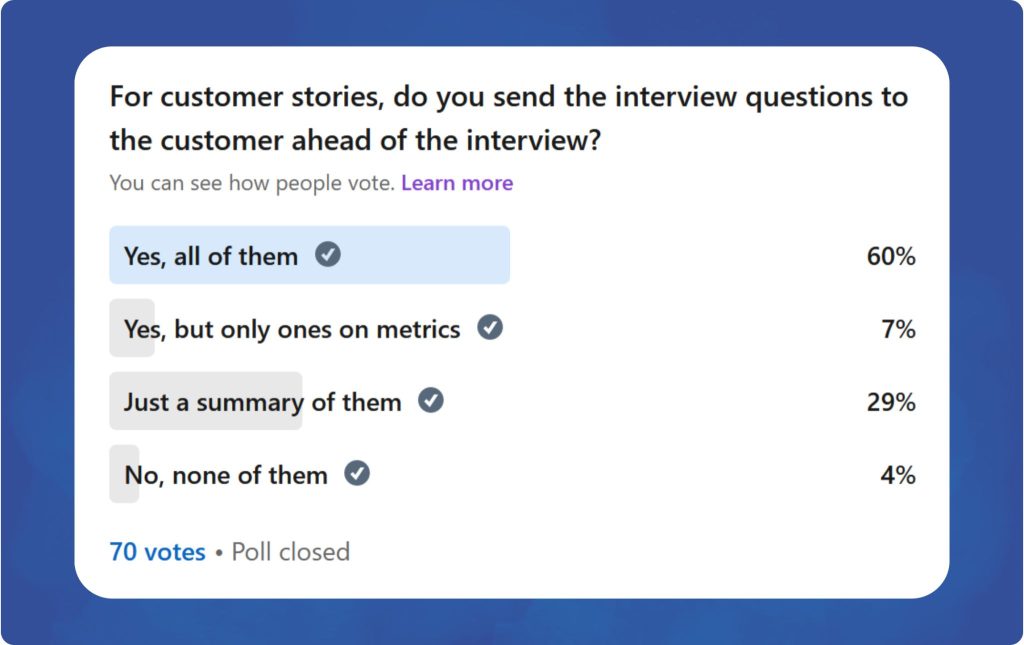
I think we can all agree that we want our customers to be at ease during the interview. At the very least, that means sending the metrics-related questions ahead of time.
Want to scale your case study production? Partner with Uplift.
Make your customer comfortable
Before the interview starts, it’s important to make the customer feel comfortable and explain the process—what to expect during the interview and after. Make sure the customer understands that they have complete control over what’s included in the final draft.
“Thank you so much for agreeing to tell us your story. Once we write the story, we’ll send it to you to review. We won’t publish anything you’re not 100% happy with. Are you okay if I record the call?”
26 case study questions for interviews with customers
Get 26 case study questions, PLUS 19 bonus questions for use case, adoption and switcher stories. Download the cheat sheet now.
Introductions and warm-up
1. Can you briefly tell me about yourself and your role?
2. What is most meaningful to you about the work you do?

Case study question #2 makes the story more personal and the answer often aligns with the company’s strategic initiatives.
3. What are you most proud of with this implementation/solution?

Case study question #3 helps put the interviewee into a positive mindset and you can sometimes get great intel that enables more detailed discussion—and this can lead to a more attention-grabbing story.
Before
4. What keeps you up at night as it relates to your job?

Case study question #4 is one of my favorites because leaders who want to drive transformation will obsess over it. They don’t “turn off” ideating at 5pm. They think about it while they’re driving, doing chores… and trying to fall asleep. So for me, this question allows me to get to the core of their thinking—and you’ll often get the most human answer.
5. What was going on at your company that sent you looking for a solution like [company name]?
5a. Follow-up: Why was this such a big problem for you and your company?
5b. Follow-up: What was the consequence of doing nothing?

Case study question #5 is a non-threatening way to ask what wasn’t working, and helps bring context to the conversation.

Case study question #5b usually uncovers a longer-term or more critical potential problem and helps get to the root of the ‘so what’ of challenges.
6. Before you landed on [our solution], how did you try to solve the problem?
6a. Follow-up: Why didn’t those solutions work?
7. What criteria did the new solution need to meet?
8. What were the top 3 things you wanted to achieve with the new solution?
9. What are the 3 biggest reasons you chose [our solution] over competitors and the option of doing nothing?
9a. Follow-up: Did anything else impress you at this early stage?
Emily Amos, CEO & Founder, Uplift Content

Hot tip: Get better answers
Use rapid framing to elicit prioritized responses.
Don’t ask: Why did you purchase this solution?
Instead ask: What are the top 3 reasons you purchased this solution from us, instead of another vendor?
During
10. When you first started working with [company name], how did you come up with the implementation plan?
11. What was the implementation process like?
12. What challenges did you hit along the way and how did [company name] help you through it?

Case study question #12 is great for building trust. It’s also the #1 most frequently asked question on customer reference calls by a wide margin.
13. What changes did you notice early on? How did things progress?
14. Can you tell me about how you’re using [our solution] and how it’s helped you?
15. Was there anything that surprised you or stood out to you about [our solution]?
16. How has [our solution] made your job easier?
16a. Follow-up: What about your department or other departments? The company as a whole?
17. What has your personal experience been like working with the [solution/team]?
18. If you couldn’t use our solution ever again, what would that be like?

Case study question #18 can lead to some great sound bites.
Hot tip: Create distance
Say to your customer: “Assume I know nothing.”
This encourages the customer to provide more context, which is where the golden nuggets really come out.
After
19. What would you consider to be the biggest success of your relationship with [company name]?
20. What can you do now that you couldn’t do before?
Case study question #20 is great for eliciting before/after context.
21. Where have you seen the biggest increase/impact?
21a. Follow-up: Can you quantify those results? For example…

Case study question #21a helps you encourage the interviewee by mentioning specific metrics or outcomes.
22. What have these results meant for your business?
22a. Follow-up: Were you expecting to see the type of results you experienced?

Case study question #22 gives the interviewee an opportunity to explain how the results are personal and meaningful.
23. How has [company name] evolved with you? How has it managed to remain your ideal solution both then and now?
23a. Follow-up: Can you think of an example of how working with [company name] has changed your thought process, strategy or the way you do business?
Case study question #23 can open up unique avenues of questioning and capture the dynamic nature of the relationship between you and your customer.
24. What unexpected benefit did you find or what did you learn along the way that you’ll take with you through your career?

Case study question #24 is great because it gets the customer excited about what they do.
25. If another company asked you if you would recommend working with us, what would you say and why?

Case study question #25 is helpful because it gets the interviewee to provide quotes that summarize the company’s value props succinctly.
26. Is there anything you wish I’d asked?

Case study question #26 can give you some of your best quotes.
Bonus case study interview questions
Do you want your case studies to have a particular focus? Do you want to tell a:
- Use case story?
- Adoption story?
- Competitive steal story?
Do you want to create:
- Customer-led blog posts providing advice or best practices?
- Customer-led blog posts providing thought leadership?
- Video stories?
If you answered yes…
…you need specific case study interview questions.
We created a cheat sheet with the 26 case study questions above, PLUS 19 additional questions for stories with a specific storyline or focus.
Download the interview questions cheatsheet – with the 19 bonus questions.
An email interview won’t cut it
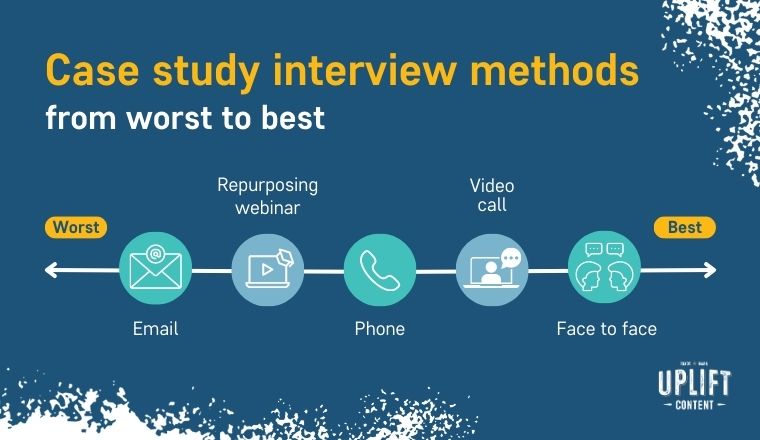
Don’t settle for a case study interview done by email. Not only are people more candid in conversation, but you’ll also be able to ask spur-of-the-moment case study questions and explore ideas as they’re presented.
Here are the 4 best ways you can conduct your case study interview:
- face-to-face (this is the best and most personable choice; try to arrange this if your customer is in your region)
- video call
- phone interview
- repurposing webinar
Take notes and record the interview
A recording and transcription of the case study interview will ensure accuracy and give you peace of mind. Down the road, you can also use the transcript for other marketing activities, such as grabbing testimonials and pull quotes, writing blog posts and more.
Use an app to record phone calls, or use Zoom or Google Meet to record video calls. Make sure you have permission to record the conversation.
Learn how to write a SaaS case study in 9 steps.
Watch out for these 4 common interview mistakes
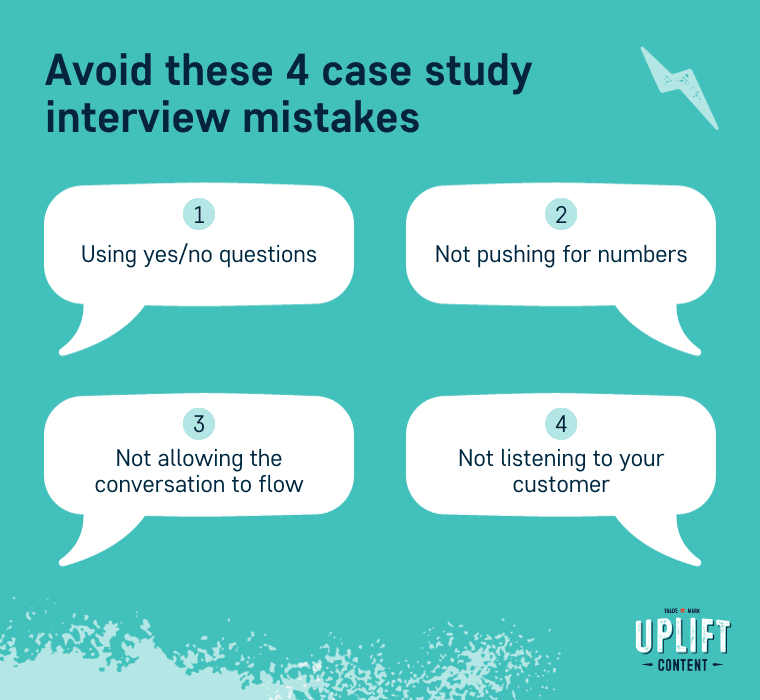
1. Using yes/no questions
Does your list have any yes/no questions? If so, be ready with follow-up questions. Better yet, revise the case study question so it’s open-ended to elicit a more thoughtful response.
2. Not pushing for numbers
Don’t be afraid to ask for case study metrics, concrete examples or more information. You need these for a quality case study and this is your chance to get them. Don’t be afraid to repeat case study questions or rephrase them to make sure you get what you need.
3. Not allowing the conversation to flow
You don’t need to be rigid about asking every single question on your list. The best insights are often unexpected so allow the conversation to flow a little—but don’t get too far off-topic or you’ll run out of time.
4. Not listening to your customer
Don’t think you already have all the answers. Go into the case study interview with an open mind and be ready to listen.

Scale your case study production
We write case studies for high-growth SaaS companies like ClickUp, WalkMe and Lean Data. Check out our case study writing service.
